Remote monitoring for heart failure: what the evidence shows
Heart failure readmissions are not random. In the days before a patient feels sick enough to call the clinic, fluid is already building quietly in the lungs and legs. The warning signs are there. The problem is that no one sees them until the patient ends up back in the emergency department. Remote monitoring for heart failure is built around exactly this gap, intercepting that silent deterioration before it becomes a crisis.
Heart failure is one of the leading causes of 30-day hospital readmissions in the United States, according to CMS readmission data. The intervention window is short, and it closes fast. By the time shortness of breath becomes severe enough to force a call, the decompensation is already advanced and the clinical options are narrower.
Daily data transmission and a trained care team watching for threshold breaches can detect deterioration days earlier than symptom-driven care in many programs. Programs like RemoteHCS, a nationwide RPM service built specifically for chronic cardiac conditions, operate on this model. That model includes condition-specific device tracking, HIPAA-encrypted data transmission, and a Medicare-compatible structure that makes continuous monitoring financially sustainable for the patients who need it most.
This guide covers what gets monitored, how care teams respond, what the clinical evidence actually shows, and how to identify the patients most likely to benefit.
What remote monitoring tracks in heart failure patients
The three daily vitals that matter most
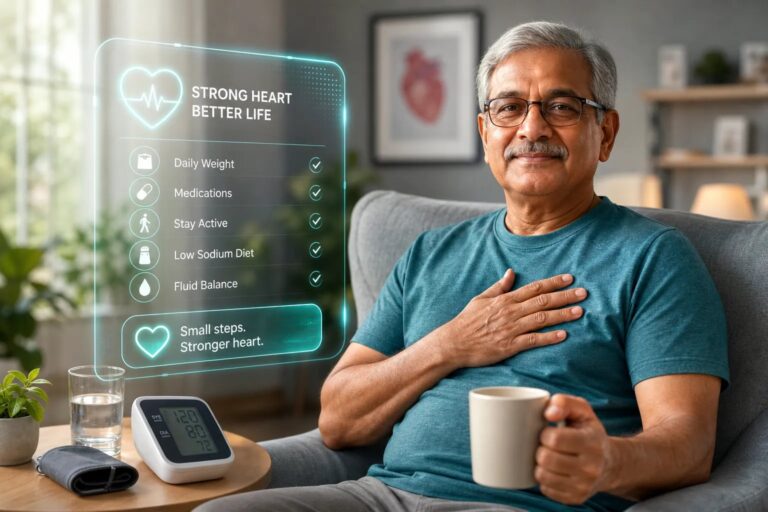
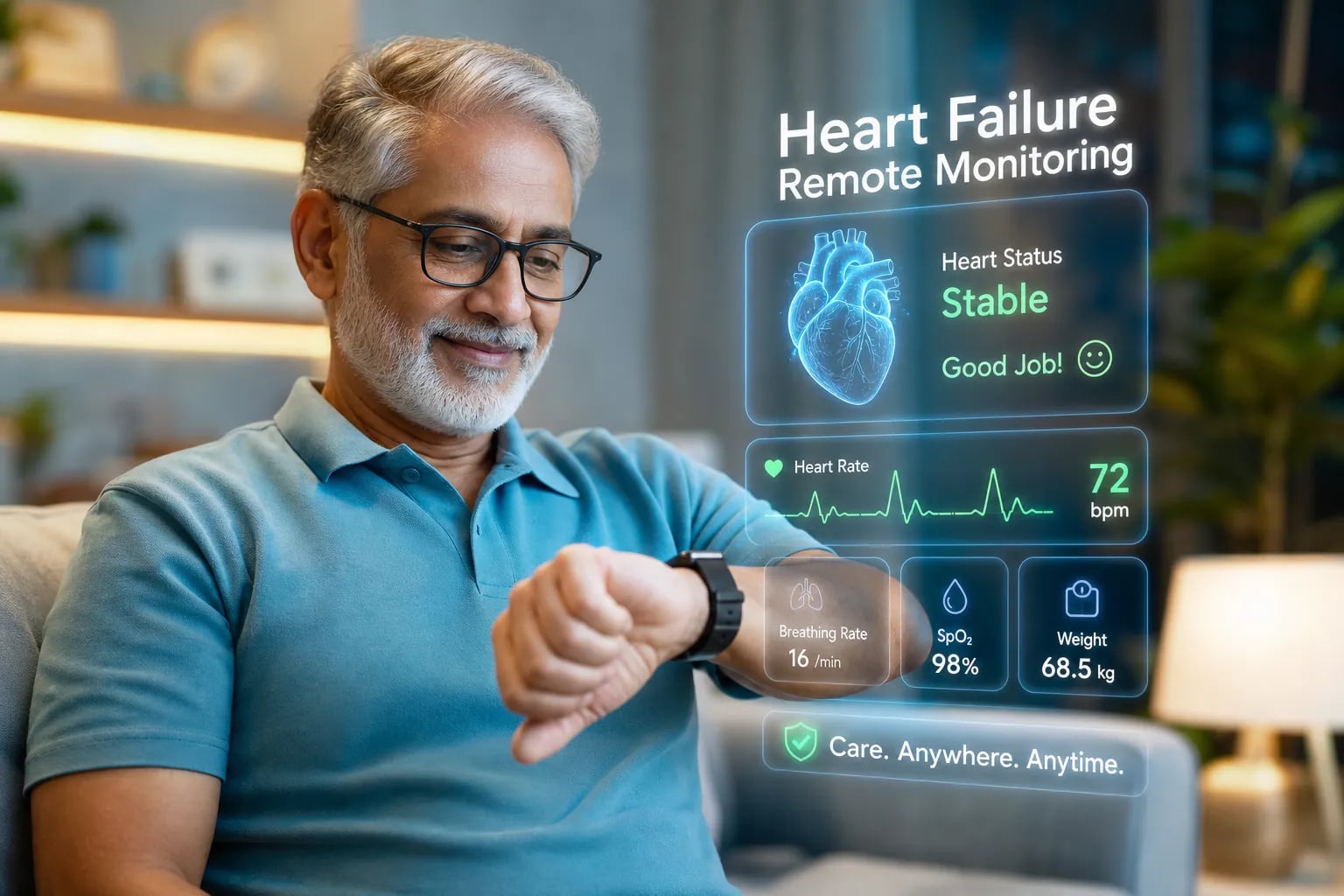
Weight, blood pressure, and oxygen saturation form the core monitoring triad for heart failure, and each one tells a different part of the same story. Weight is the earliest and most reliable signal of fluid retention: a gain of two to three pounds in 24 hours is a clinically actionable threshold, not a coincidence. Blood pressure reveals whether the heart is compensating adequately or beginning to lose the ability to maintain sufficient output, trends in either direction carry different management implications. SpO2 serves as a complementary signal of developing pulmonary compromise in some patients, though it may remain normal until congestion becomes more advanced, so it is best interpreted alongside weight and symptom data rather than in isolation.
How connected devices transmit data automatically
Bluetooth-enabled and cellular-connected scales, blood pressure cuffs, and pulse oximeters send readings directly to a secure clinical dashboard after each measurement. The patient does not log anything manually or make a judgment call about whether a number is concerning. That cognitive burden shifts to the care team, where it belongs. Purpose-built RPM programs for heart failure then map each device reading to the specific physiologic signals that drive decompensation risk, a meaningful distinction from collecting generic wellness data that a clinician cannot readily act on.
Beyond the basics: additional signals some programs track
Higher-risk patients may benefit from supplementary monitoring that captures resting heart rate trends, step counts, and symptom questionnaires covering shortness of breath and ankle swelling. Some programs incorporate wearable heart failure monitors that track fluid status through bioimpedance, adding digital biomarkers in heart failure management that go beyond standard vital signs. At the most intensive end, implantable pulmonary artery pressure monitors such as CardioMEMS provide direct hemodynamic data for NYHA class III patients, though these represent a clinical escalation within the remote monitoring ecosystem rather than a starting point.
Why fluid buildup is the real danger in heart failure
How decompensation develops before symptoms appear
When the heart loses pumping efficiency, the kidneys respond by retaining sodium and water. That compensation raises filling pressures and moves fluid into the lungs and extremities over several days. The patient may not feel meaningfully worse until the accumulation reaches a tipping point, which is exactly when the clinical situation becomes urgent. Waiting for symptoms to drive the call eliminates the window where outpatient therapy adjustment could prevent hospitalization.
Why weight is the most actionable early warning sign
Standard heart failure management protocols treat weight gain as an immediate action signal: more than two pounds in a single day or five pounds in one week typically triggers direct patient contact, consistent with thresholds described across clinical guidelines and monitoring studies. An RPM program that captures daily weight automatically catches that trend at day one or two, giving the care team several days to adjust diuretics before the patient crosses into decompensation. This is the structural value proposition of home monitoring for heart failure exacerbation: replacing a reactive emergency response with a proactive therapy adjustment.
How care teams respond when warning signs appear
What happens when a threshold is breached
When a patient’s scale records a significant weight gain, the platform triggers an alert to the care coordinator or supervising clinician. The care team contacts the patient, assesses symptoms, and determines the appropriate next step, a diuretic dose adjustment, a scheduled telehealth visit, an in-person evaluation, or an emergency referral. This is an active intervention loop, not passive data collection. The data by itself does not prevent hospitalizations. Acting on the data does.
The role of the care coordinator in daily RPM
The care coordinator is the first responder in RPM-based heart failure management. They review flagged readings, make initial contact, escalate to supervising clinicians when the clinical picture warrants it, and document the encounter. This model keeps patients connected to their care team between scheduled appointments, the structural gap where most heart failure deteriorations occur. The coordinator’s role is not administrative: it is clinical triage at scale.
When RPM escalates to a virtual consult
When the care coordinator determines that a patient’s trend requires clinician review, the escalation moves to a telehealth heart failure management visit. The clinician reviews recent trend data, interviews the patient, and issues orders or prescription changes without requiring travel. For some mobility-limited or rural patients, this virtual escalation may reduce what would otherwise be an emergency department visit, in programs where the evidence supports that outcome. The patient gets timely care, and the care team addresses the problem before it progresses.
What the evidence shows about remote monitoring outcomes
What recent meta-analyses consistently report
Systematic reviews consistently show pooled reductions in hospitalizations and mortality, though the magnitude varies by program design and patient population. A 2026 comparative meta-analysis across 79 randomized trials found that remote monitoring reduced total heart failure hospitalizations (incidence rate ratio 0.81), first HF hospitalizations (risk ratio 0.82), and all-cause mortality (risk ratio 0.90). A 2025 meta-analysis reported a 22 percent reduction in first HF hospitalization and a 19 percent reduction in mortality.
A broader analysis across 92 studies found consistent associations with lower mortality, fewer first HF hospitalizations, and fewer total HF hospitalizations. Importantly, programs lasting 12 months or more show stronger hospitalization benefits than shorter interventions, and programs with structured self-management and education modules produce additional gains, findings that reinforce the importance of program design alongside the technology itself.
Where implantable sensors fit in the evidence
CardioMEMS, the FDA-approved implantable pulmonary artery pressure monitor, carries the strongest single-device evidence base in this space. In a post-approval registry of 1,200 patients, HF hospitalizations fell significantly in the year after implantation compared to the year before, with a hazard ratio of 0.43. CardioMEMS is indicated for NYHA class III patients with a prior HF hospitalization, with later FDA approval extending to class II patients and those with elevated natriuretic peptides. It is a clinical escalation tool for higher-risk patients and sits within the broader remote monitoring ecosystem rather than replacing standard non-invasive RPM.
Why individual RCTs sometimes showed no benefit
The evidence is not uniformly positive, and that honesty matters for program design. Tele-HF, one of the largest early randomized trials, found no reduction in readmission or death with automated daily telemonitoring. The reason is not that monitoring fails. It is that data collection alone does not prevent hospitalizations. Program design, patient selection, and the intensity and speed of the clinical response to alerts are what drive outcomes. A monitoring platform with no reliable escalation process is infrastructure without function.
Who is the right candidate for heart failure RPM
Characteristics that predict the most benefit
The patients who benefit most from non-invasive home RPM share a consistent profile across trials and coverage criteria. NYHA class III symptoms, a heart failure hospitalization within the past 12 months, ongoing fluid management needs, and sufficient engagement capacity are the clearest predictors. Patients with volume-sensitive physiology, where the clinical course is driven by congestion and diuretic titration, are the strongest mechanistic fit. The monitoring gives clinicians the data to adjust therapy before decompensation occurs, but only if there is meaningful decompensation risk to begin with.
When RPM is not the right fit
End-stage heart failure patients on chronic inotropes or awaiting LVAD or transplant are poor candidates because the clinical response options to monitoring data are limited. Very advanced renal dysfunction reduces the ability to act on fluid signals through diuretic adjustment, which is the primary intervention RPM enables in this population. Patients who cannot reliably engage with devices or respond to care team outreach will not benefit regardless of the technology used. Matching the monitoring to the patient’s actual situation is the first clinical decision in any RPM program.
How to match monitoring intensity to patient risk
Stable, lower-risk patients do well with standard RPM covering daily weight, BP, and SpO2. Higher-risk patients with recurrent decompensation may need more intensive monitoring protocols, more frequent symptom check-ins, supplementary biomarkers, or wearable sensors. This tiered approach is what distinguishes a condition-specific RPM program from a general telehealth platform. The technology should match the clinical problem, not the other way around.
How Medicare covers remote monitoring for heart failure in 2026
The CPT code framework for HF RPM billing
Heart failure qualifies as a chronic condition under Medicare’s RPM benefit, and the 2026 code set covers the full range of monitoring and management services. The core codes are 99453 for initial device setup and patient education, 99454 for device supply with 16 or more days of data transmission in a 30-day period, 99457 for the first 20 minutes of monthly clinical management with interactive communication, and 99458 for each additional 20 minutes. Two codes that took effect in 2026 expand the billing framework: 99445 covers device supply for shorter monitoring periods of 2 to 15 days, and 99470 covers the first 10 minutes of monthly management time. These additions lower the threshold for patients who cannot transmit data every day of the month.
What 2026 reimbursement looks like in practice
Approximate 2026 Medicare payment rates are roughly $22 for 99453, $47 to $48 for 99445 and 99454, $52 for 99457, $41 for 99458, and $26 for 99470. The 2026 changes create a billable pathway for shorter monitoring periods and shorter management windows, which expands the eligible population and reduces program revenue risk when adherence varies month to month. Traditional Medicare’s RPM coverage rules apply nationwide and are separate from Medicare Advantage and commercial plan medical-necessity policies, which vary by insurer.
How RemoteHCS aligns with Medicare-compatible RPM for heart failure
RemoteHCS operates across all 50 states as a nationwide RPM service structured around the Medicare billing model that makes remote monitoring financially accessible to Medicare-eligible patients carrying the highest heart failure burden. Its condition-specific device tracking, covering weight, blood pressure, SpO2, and other cardiac-relevant parameters, maps directly to the physiologic signals that Medicare covers under the RPM benefit. For patients managing heart failure at home and the care teams responsible for them, this structure supports daily monitoring that is both clinically grounded and financially sustainable over time.
Putting the evidence into practice
Heart failure is manageable between appointments, but only if the care team has daily data to act on. Pooled research consistently shows that remote monitoring reduces hospitalizations and mortality, particularly in higher-risk patients, longer-duration programs, and settings where the clinical team responds to alerts quickly and with a clear escalation pathway. Individual trials have been mixed, and outcomes depend heavily on how a program is designed and executed.
The technology is not the hard part. What separates programs that produce outcomes from those that collect data without impact is a responsive care team, a structured escalation process, and monitoring matched to the patient’s actual risk level. A general telehealth platform is not the same thing as a condition-specific RPM program designed around the physiology of heart failure.
For patients and caregivers evaluating options, the right RPM program does more than collect numbers. It creates a continuous clinical connection that catches the warning signs daily life tends to hide. If you or someone you care for is managing heart failure and wants to understand what enrollment in a nationwide, Medicare-compatible RPM program looks like, RemoteHCS is built around this model. The monitoring starts before the next hospitalization, not after.