Home blood pressure monitoring: the complete guide
Home blood pressure monitoring is one of the most practical tools available for managing hypertension, yet many people do it wrong. They use an unvalidated wrist device, skip the five-minute rest period, or record numbers in a notebook that never leaves the kitchen drawer. That gap between measuring and actually doing something with the data is where chronic hypertension gains ground. Uncontrolled high blood pressure remains a leading driver of heart attack, stroke, and kidney failure in the United States, a pattern documented consistently in CDC mortality data and AHA cardiovascular disease statistics, and a single office reading is often not enough to paint the full picture of what’s happening in your body between appointments.
Home blood pressure monitoring done correctly gives clinicians a far more accurate view of your true average pressure than any snapshot taken in an exam room can. Some patients read high only when they’re anxious in a clinical setting; others read normal at the office while their home averages are well above safe limits. Both patterns lead to misdiagnosis without home data to fill in the gaps. Newer connected care services now transmit home readings directly to licensed clinicians in real time, closing the distance between measurement and meaningful clinical response. By the end of this guide, you’ll know exactly how to measure correctly, which devices to trust, how to interpret your numbers, and how to make sure those results actually reach someone who can act on them.
Why home readings often tell a fuller story than office visits
The white-coat and masked hypertension problem
An office blood pressure reading is a snapshot taken under artificial conditions: a waiting room, a stranger’s stethoscope, and the mild anxiety most people feel in a clinical setting. Multiple prospective cohort studies estimate that white-coat hypertension causes somewhere between 15 and 30 percent of patients to read elevated at a clinic when their true blood pressure is perfectly normal, though the precise figure varies across populations and measurement protocols. Masked hypertension is the opposite problem: readings appear normal in the office while home averages are critically high. Both conditions lead to real harm, either through unnecessary medication or through undertreated hypertension that damages the heart and kidneys quietly over years.
The U.S. Preventive Services Task Force (USPSTF) recommends confirming hypertension with out-of-office measurements before initiating treatment, specifically because office readings alone are insufficient. A consistent series of home averages gives clinicians something far more reliable to work from.
Home blood pressure monitoring vs. 24-hour ambulatory monitoring
Ambulatory blood pressure monitoring (ABPM) is the clinical reference standard for detecting nocturnal hypertension and non-dipping patterns, because it captures readings continuously across the full day and night. Studies using ABPM as the benchmark show that home blood pressure monitoring (HBPM) has a sensitivity of roughly 47 to 74 percent for detecting white-coat and masked hypertension, with a specificity of 86 to 94 percent. In other words, HBPM is highly reliable when it flags a problem, but it can miss some cases that ABPM would catch.
That does not make home monitoring less valuable for daily management. It is practical, widely available, reproducible, and far easier to sustain over weeks and months than wearing an ambulatory monitor. Home monitoring complements ABPM rather than replacing it. For ongoing chronic condition management, consistent home data is exactly what a care team needs.
How to pick a clinically validated monitor and the right cuff size
What “clinically validated” actually means for home blood pressure monitoring
Not every device sold as a blood pressure monitor has been tested for accuracy. Three independent organizations maintain public registries of monitors that have passed standardized validation protocols: STRIDE BP, the dabl Educational Trust, and the British and Irish Hypertension Society (BIHS). STRIDE BP further designates a “Preferred” tier for devices that meet stricter criteria, including an upper-arm cuff design and recent validation evidence. Research comparing validated and non-validated devices, summarized across the STRIDE BP and dabl databases, shows that unvalidated monitors can read several mmHg off true pressure, which is enough to misclassify a patient’s hypertension status entirely.
Always choose a validated upper-arm monitor. Wrist monitors are prone to positional error and are not recommended for routine home blood pressure measurement. Check the STRIDE BP website before purchasing; the list is free, searchable, and updated regularly. Devices in the Preferred tier represent the safest starting point for most patients.
Getting the cuff size right (this matters more than most people realize)
Cuff size is determined by mid-upper arm circumference, and using the wrong size introduces meaningful error. Research consistently shows that a cuff one size too small typically overestimates systolic pressure by roughly 5 to 10 mmHg; in more extreme mismatches, errors can reach 20 to 30 mmHg, enough to prompt treatment a patient does not need or delay treatment they do. The sizing ranges are straightforward:
- 22, 26 cm: Small adult cuff
- 27, 34 cm: Regular adult cuff
- 35, 44 cm: Large adult cuff
- 45, 52 cm: Extra-large cuff
Measure your arm before you buy a monitor. Most validated devices include one standard adult cuff; if your arm circumference falls outside the 27 to 34 cm range, you will likely need to purchase a different cuff separately. Re-check your arm circumference after significant weight changes, since cuff fit shifts with body size.
Home blood pressure monitoring: step-by-step technique for accurate readings
What to do before you sit down
Preparation is where most home readings go wrong, and the mistakes are easy to make without realizing it. For at least 30 minutes before measuring, avoid caffeine, tobacco, and exercise. Empty your bladder. Sit quietly for five full minutes in the room where you’ll measure, with your phone put away and the television off. These steps reflect AHA/ACC protocol directly and make a measurable difference in accuracy.
Positioning, cuff placement, and the reading itself
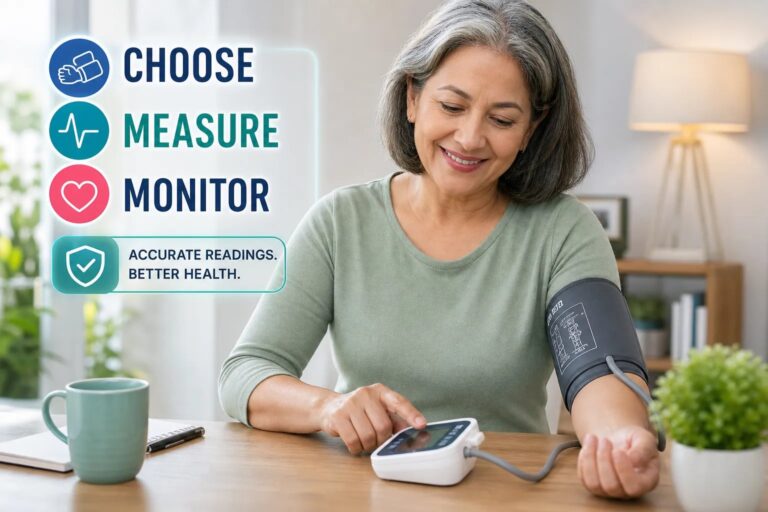
Sit in a chair with your back fully supported and both feet flat on the floor. Do not cross your legs. Rest your arm on a table so the cuff sits at heart level. Place the home blood pressure cuff on your bare upper arm, not over a sleeve or sweater, with the bottom edge positioned just above the bend of your elbow. Do not talk during the measurement. Take two readings, one minute apart, in the morning before you take any medications, and again in the evening before dinner. Record both results each session.
The standard protocol recommended by the AHA and AAFP calls for two morning and two evening readings daily for seven days. That gives your clinician 28 data points to average, which is far more meaningful than a single office reading taken once a quarter.
Troubleshooting common mistakes that skew your numbers
Positioning and timing errors
The most common errors that inflate or deflate readings are also the easiest to overlook. Measuring with the cuff over a sleeve adds resistance and artificially elevates the reading. An arm hanging unsupported at your side rather than resting on a table does the same. Crossing your legs increases peripheral vascular resistance and can modestly raise systolic pressure, some studies have reported increases in the range of 2 to 8 mmHg, though the effect varies by individual. Measuring within 30 minutes of coffee or exercise is another frequent mistake that produces numbers not reflecting resting pressure at all.
Each of these errors can shift a reading by several mmHg on its own. Combined, they can push a result 20 mmHg or more above or below your true average, a range supported by guideline reviews of common measurement error sources. The fix is simply following the preparation and positioning steps consistently, every time, without shortcuts.
Device and cuff errors
Wrist monitors introduce positional error that is difficult to control reliably, and no major clinical organization recommends them for routine home blood pressure monitoring. Cuff fit is just as important as device choice: a cuff one size too small typically overestimates systolic pressure by 5 to 10 mmHg, with larger errors in extreme mismatches. If you have gained or lost a meaningful amount of weight recently, re-measure your arm circumference and confirm your cuff still fits correctly before relying on recent readings.
What your home blood pressure numbers actually mean
Home thresholds vs. office thresholds
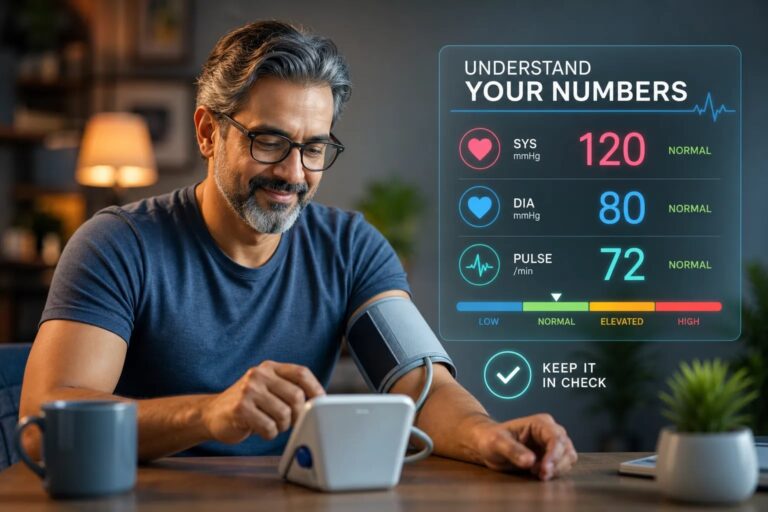
Home averages and office readings do not use the same diagnostic cutoffs, and confusing them leads to misinterpretation. Under U.S. ACC/AHA guidelines, a home average of 130/80 mmHg or higher meets the threshold for hypertension in adults. Many international guidelines use a slightly higher home equivalent of 135/85 mmHg, which corresponds to an office reading of 140/90 mmHg in those frameworks. If your care team follows U.S.-based ACC/AHA guidance, 130/80 is your reference benchmark unless your clinician specifies otherwise.
When to call your doctor and when to call 911
Consistently elevated home averages at or above your clinician’s target threshold should be reported at your next check-in or sooner. A reading above 180 systolic or 120 diastolic, even without symptoms, warrants a same-day call to your provider, the AHA classifies this range as a hypertensive crisis requiring prompt clinical evaluation. That reading falls in the severe range, and your clinical team needs to know about it without delay.
If a severely elevated reading comes with chest pain, shortness of breath, sudden severe headache, confusion, vision changes, or weakness, call 911 immediately. That combination defines a hypertensive emergency. It is not a “wait until morning” situation, and it is not something to manage by taking an extra dose of medication at home.
Logging results and getting them to your care team
How to log readings manually (and why most people stop)
The AHA recommends logging at least seven days of morning and evening readings before a clinical appointment so your care team can calculate a meaningful average. A blood pressure log at home, whether a paper form or a simple spreadsheet, with the date, time, and both readings from each session does the job. In practice, many patients log inconsistently, forget to bring records to appointments, or only share numbers when something alarming prompts them to call. The manual burden is real, and the data gaps it creates are exactly where clinically important changes get missed.
How connected care changes the equation
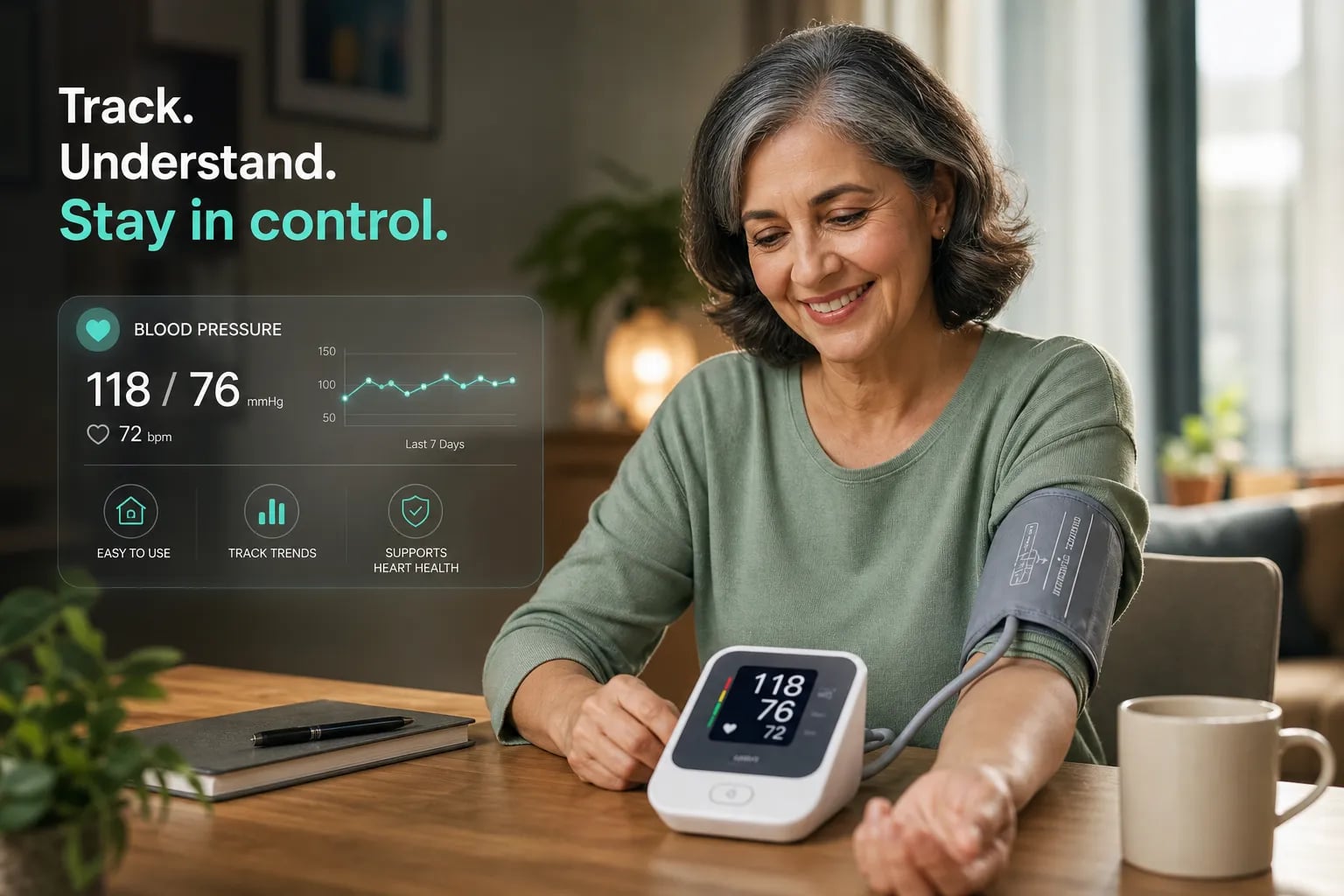
RemoteHCS equips patients with connected blood pressure devices that transmit readings directly to a licensed clinical team, eliminating paper logs, manual uploads, and the uncertainty of whether anyone reviewed the data. Clinicians receive alerts when readings fall outside target ranges, enabling a faster response without requiring the patient to initiate anything. For someone managing hypertension alongside heart failure, kidney disease, or diabetes, that kind of continuous visibility between appointments is precisely what keeps small changes from escalating into hospital visits.
The distinction between a monitoring program and a connected care program comes down to what happens after the reading is taken. A reading that stays in a notebook is a data point. A reading that reaches a care coordinator promptly becomes part of active clinical management. RemoteHCS is currently building its nationwide waitlist for patients ready to make that shift. The program is designed to be compatible with Medicare coverage, and prospective patients are encouraged to confirm specific coverage details directly with RemoteHCS and their insurer.
Putting it all together
Home blood pressure monitoring works when you use a clinically validated upper-arm device with the correct cuff size, follow the five-minute rest and proper positioning steps consistently, take two readings morning and evening for at least seven days, and understand which numbers require action. That framework is not complicated, but it does require consistency. The data is only as useful as your ability to collect it accurately and get it to someone who can interpret it in clinical context.
Manual logging helps, but it depends entirely on patient follow-through. For people managing chronic conditions where blood pressure is one of several variables being tracked, the stronger approach is a system that handles transmission automatically so the focus stays on health, not paperwork. Real-time clinical oversight transforms home blood pressure monitoring from a personal record-keeping exercise into an active part of your care. If you want your readings reviewed by a licensed care team between appointments, RemoteHCS offers a connected care model built around exactly that goal, with clinical staff available to respond when the numbers warrant it.