What Is RPM in Healthcare? How It Works and Why It Matters
What is RPM healthcare, and why does it matter for patients who spend most of their lives between office visits? Many health crises for patients with chronic conditions don’t occur in the exam room, they happen on a Tuesday afternoon, three weeks after a follow-up visit, when a blood pressure reading spikes to 178/112 and no one on the care team knows about it until the patient arrives in the emergency department. That gap between scheduled appointments is exactly where remote patient monitoring was built to operate.
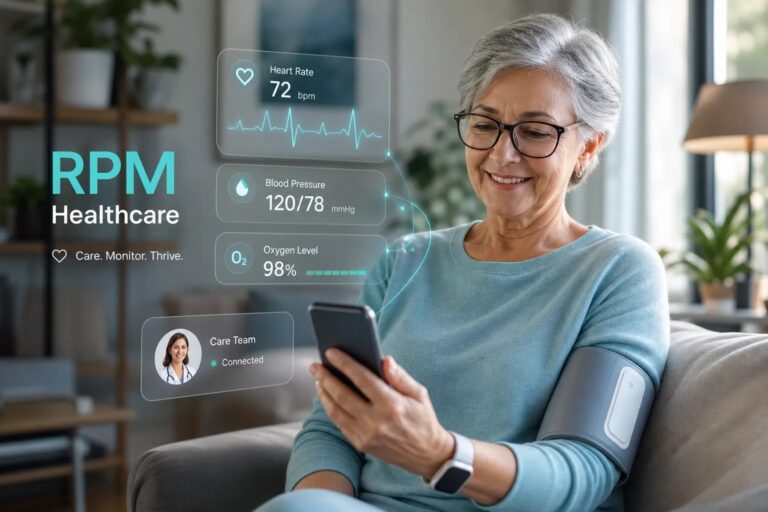
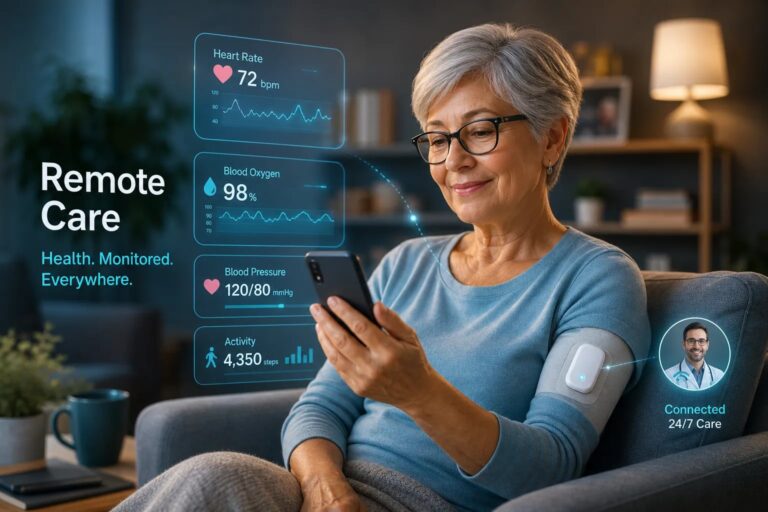
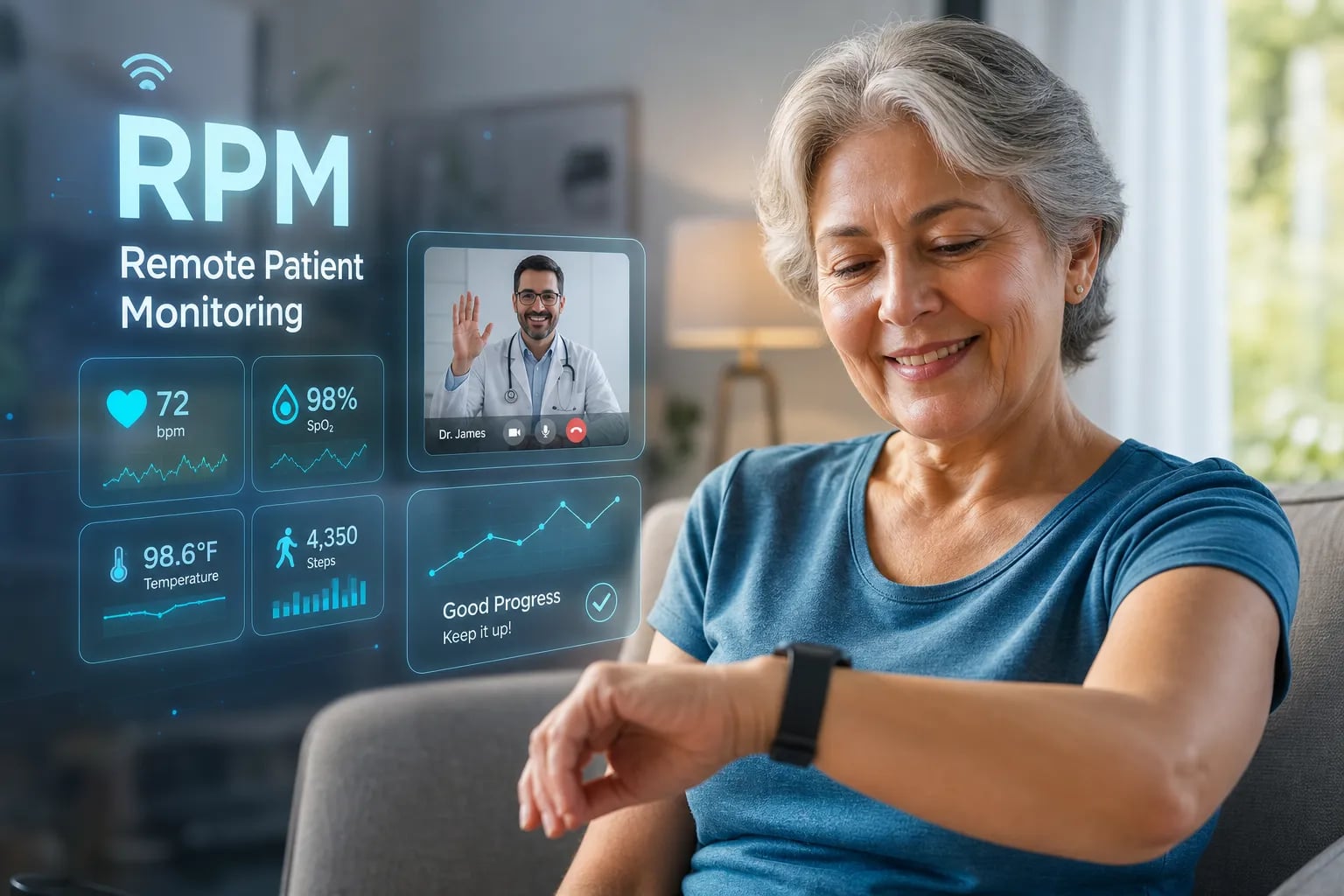
Remote patient monitoring, commonly called RPM, is a form of telehealth that uses connected medical devices to collect a patient’s physiologic data at home and transmit it to a clinical team for review and action. It’s not a portal message. It’s not a nurse call line. It’s a structured, reimbursable care delivery model with continuous data, documented clinical protocols, and defined escalation pathways. RemoteHCS is one example of a fully operational, HIPAA-compliant RPM model: condition-specific devices, licensed clinician oversight, and care team communication spanning all 50 states, without requiring the patient to leave home.
This article walks through what RPM in healthcare looks like in clinical practice, which conditions have the strongest supporting evidence, which remote monitoring devices power these programs, how Medicare reimburses RPM services under 2026 rules, and a five-step framework for launching a program that holds together after go-live.
What is RPM healthcare: how it actually works in clinical practice
From patient enrollment to first transmitted reading
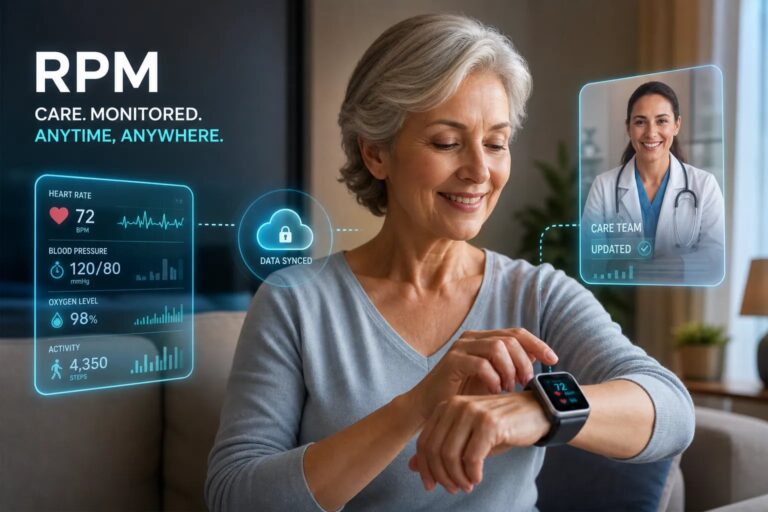
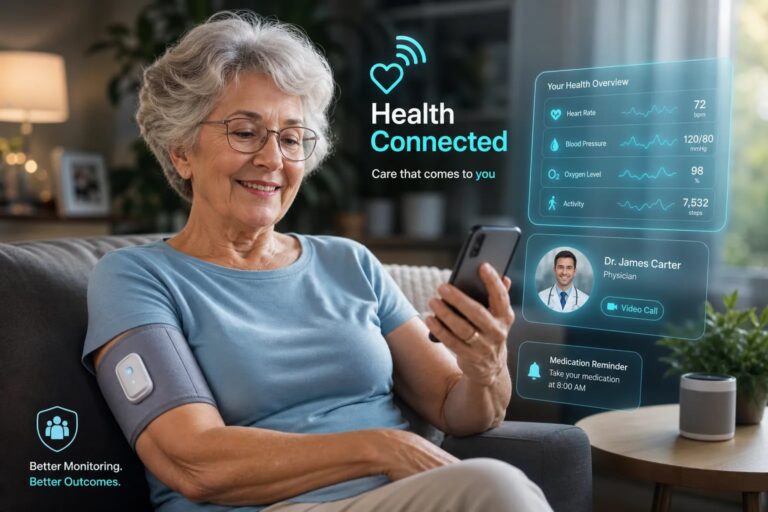
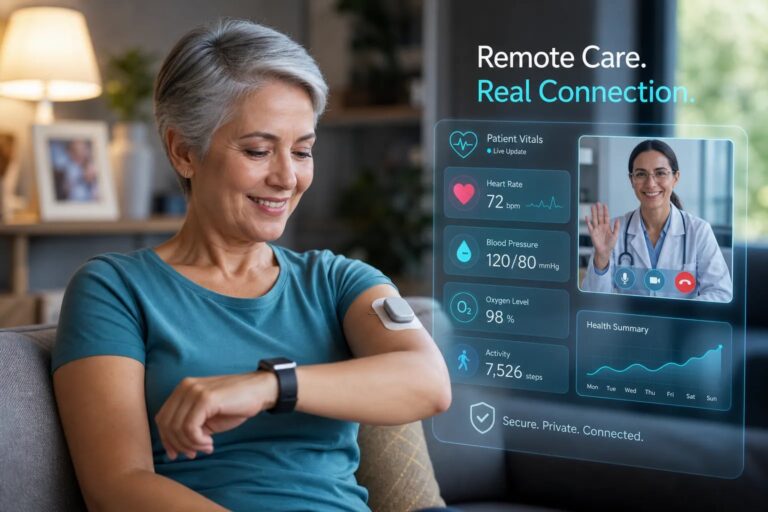
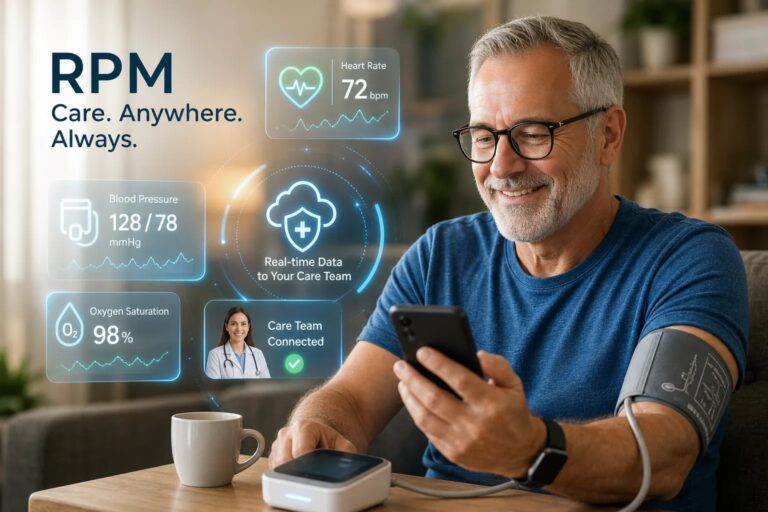
The front end of an RPM workflow starts with a clinician identifying an eligible patient, placing an RPM order, and documenting consent. The patient receives a connected device, such as a blood pressure cuff, a pulse oximeter, or a smart scale, along with instructions on when and how to measure. Most remote monitoring devices transmit automatically through Bluetooth or cellular connection to a monitoring platform; the patient doesn’t log into a portal or manually enter readings (though some device types and workflows still require manual steps). That low-friction data flow is by design, because patient adherence is what makes the program clinically useful.
The patient measures vitals on a set schedule, often daily, and readings typically appear in the clinician’s monitoring dashboard within minutes, though exact timing varies by device, connectivity, and platform. This is not passive data collection sitting in a database. A nurse or monitoring coordinator actively reviews transmissions, usually on a daily or per-alert basis through a dedicated monitoring platform, looks for trends, and acts on what they see. That layer of accountable clinical review is what separates RPM from consumer wellness tracking.
What happens when the data arrives
On the care-team side, the coordinator reviews incoming readings against pre-set thresholds. When a value falls outside the defined range, the system flags it and the coordinator reaches out to the patient directly. Depending on severity, that might mean a medication reminder, a brief check-in call, or escalation to the physician for urgent review. Automated alerts shorten the window between a dangerous reading and a clinical response, a commonly cited mechanism of benefit in RPM implementation literature, which is where the model earns much of its clinical value. The device is the input; the structured clinical action is the output. Programs that treat RPM as a data feed without a defined escalation workflow undermine that value entirely: without someone accountable on the other end, alert fatigue accumulates and dangerous readings go unaddressed.
How RPM differs from a standard remote check-in
Understanding what RPM in healthcare means also requires knowing what it is not. RPM is not a nurse triage line or a patient portal message. It’s a defined service with continuous physiologic data, a documented care plan, a monitoring cadence, and reimbursable clinical time. That structure is what separates it from informal follow-up calls. CMS requires medical necessity documentation, patient consent, an FDA-cleared connected device, and data transmission for at least two days in a 30-day period just to open a billing episode. The rigor is intentional because the clinical accountability it produces is the point.
Which patients and conditions benefit most from RPM
The conditions with the strongest clinical evidence
Heart failure, hypertension, and COPD have the most consistent evidence behind them. For heart failure, multiple meta-analyses published over the past several years show fewer hospitalizations and better quality of life when patients are monitored remotely between visits. For hypertension, RPM produces meaningful blood pressure improvement, particularly in patients with uncontrolled readings. For COPD, the data consistently shows reduced acute care visits and fewer emergency presentations. These three conditions form the core clinical case for RPM programs and the strongest argument for prioritizing them in a new launch.
The evidence for diabetes, chronic kidney disease, and asthma is promising but more variable. Diabetes RPM shows benefit in some studies, but the economic and outcome data is less consistent than what exists for heart failure or COPD. That doesn’t mean RPM doesn’t work for these conditions; it means the clinical team should set expectations accordingly and measure outcomes carefully.
Patient populations where RPM adds the most value
Beyond diagnosis, high-value RPM candidates tend to share a few characteristics. Patients with multiple chronic conditions who require continuous monitoring to catch dangerous changes before they become hospitalizations are a natural fit. So are patients recently discharged from a hospital or surgical procedure who need a clinical safety net between follow-up appointments. Rural or mobility-limited patients for whom frequent in-person visits are not logistically feasible represent a third strong use case. These populations overlap significantly with Medicare-eligible seniors, which helps explain why telehealth RPM adoption and Medicare coverage have expanded together over the past several years.
Caregivers and family members managing a loved one’s chronic illness are often invisible stakeholders in RPM adoption. When a licensed clinical team reviews daily vitals, that’s not just clinical oversight, it’s also peace of mind for a spouse or adult child who can’t be there every day.
Where the evidence is still building
Asthma and chronic kidney disease monitoring show potential, but fewer large trials have confirmed outcomes at scale. For CKD specifically, the published evidence base is the thinnest of the major chronic conditions currently monitored via RPM. Being honest about these gaps builds credibility with clinical teams who have seen vendor claims overpromise what the science actually supports. RPM is a strong tool; it doesn’t need to be oversold to be worth implementing.
The remote monitoring devices and data types powering RPM programs
Core connected devices used in RPM programs
Five device categories cover the majority of RPM programs in clinical use today. Blood pressure cuffs are the most commonly deployed, mapped primarily to hypertension and heart failure management. Smart scales track weight trends and fluid retention in heart failure patients, often catching an exacerbation before symptoms become acute. Pulse oximeters monitor oxygen saturation in COPD and cardiac patients, where a slow SpO2 decline can signal deterioration well before the patient feels it. Glucometers and continuous glucose monitors (CGMs) cover diabetes management, CGMs like the Dexcom G7 and Abbott FreeStyle Libre 3 offer continuous trend data that fingerstick readings can’t match, and both carry FDA clearance for clinical use. Wearable sensors round out the category, capturing heart rate, activity, rhythm, and in some programs, respiratory rate.
Every remote monitoring device used in a Medicare-reimbursed RPM program must be FDA-cleared and must transmit data automatically, per CMS guidance on RPM billing requirements. Consumer wellness trackers that require manual entry don’t qualify. The distinction matters both for billing integrity and for data reliability.
What the data actually tells the care team
Weight trends catch fluid retention before a heart failure exacerbation becomes an ER visit. Daily SpO2 readings in a COPD patient can reveal a slow functional decline weeks before it becomes acute. Continuous glucose data exposes post-meal spikes and overnight patterns that a quarterly A1C can’t capture. The clinical value isn’t in the individual data point, it’s in the trend over time and the action it enables. A single blood pressure reading is a snapshot; 30 days of daily readings at home reveals the real picture of a patient’s cardiovascular status between visits.
Matching device selection to your program’s use case
The right device choice depends on the condition being monitored, the patient’s technical comfort level, and whether the platform supports EHR integration and automated alerting. Building a device library around what’s easiest to procure is a common mistake. Build it around what data the care team can actually review and act on, because a device that generates data nobody uses isn’t clinical care, it’s documentation overhead.
What is RPM healthcare reimbursement: Medicare CPT codes in 2026
The core Medicare RPM code set
Medicare has covered RPM services since 2018, and the code set has expanded significantly since then. Understanding RPM CPT codes is essential for any practice evaluating program viability. CPT 99453 covers the one-time device setup and patient education, reimbursing approximately $21.71 at the 2026 national average (per the CMS Physician Fee Schedule). CPT 99454 covers device supply when 16 or more days of data are transmitted in a 30-day period, averaging $52.11. CPT 99457 covers the first 20 minutes of monthly management time with at least one interactive communication, averaging $51.77. CPT 99458 covers additional 20-minute increments beyond 99457, averaging $41.42. These four codes form the backbone of most RPM billing programs currently in operation.
All rates are national averages; actual reimbursement varies by CMS locality, practice setting, and payer-specific contracts, with meaningful differences between high-cost and low-cost localities. Programs should pull locality-specific rates from the CMS Physician Fee Schedule Look-up Tool rather than using national averages as firm budget targets.
What changed in 2026: lower-threshold codes
CMS finalized two new codes for 2026 that reduce the all-or-nothing risk in RPM billing. CPT 99445 allows billing for device supply when only 2, 15 days of data are transmitted in a 30-day period, reimbursing approximately $52.11 (verify the current code descriptor and formal clinical thresholds via CMS or AMA CPT resources, as contractor-specific guidance may apply). CPT 99470 allows billing for 10, 19 minutes of monthly management time with at least one interactive communication, reimbursing approximately $26.05. These changes directly address one of the most persistent billing pain points in virtual care monitoring programs: patients who miss a week of readings but still received meaningful clinical oversight no longer result in zero reimbursement for that month. The lower-threshold pathway makes revenue more predictable and reduces the incentive to chase data transmission compliance at the expense of clinical judgment.
Commercial payer coverage and what to expect
Many commercial plans cover RPM using Medicare-like CPT codes, but coverage is not automatic. Most commercial payers require prior authorization and medical necessity documentation, and some impose plan-specific device and patient eligibility criteria that differ from Medicare’s rules. Commercial payers may not have adopted the 2026 lower-threshold codes yet, policy updates at large commercial insurers have historically lagged CMS by one to two years. Programs should verify each payer’s current RPM policy rather than assuming alignment with Medicare’s updated rules. Billing on assumptions is how programs accumulate recoupment risk.
A practical 5-step framework for launching an RPM program
Step 1: Define the clinical use case and target population
Before selecting devices or signing vendor contracts, the team needs to answer three questions: which condition, which patients, and what outcome are we trying to move? Uncontrolled hypertension with a readmission reduction goal is a fundamentally different program than post-discharge heart failure monitoring. Starting with a focused use case reduces scope creep, makes success measurable, and gives the pilot a realistic chance of producing data worth acting on.
Step 2: Build the workflow and assign clear role ownership
Map who identifies eligible patients, who obtains consent, who provisions and educates on devices, who monitors incoming data daily, who manages alerts, who escalates, and who documents for billing. Every handoff in that chain needs a named role, not a department. Workflow ambiguity is a leading reason RPM programs fail after launch, more so than technology problems, according to implementation literature. When no one owns a step, that step doesn’t happen consistently, and inconsistent execution produces poor transmission rates, missed alerts, and billing gaps.
Step 3: Select devices and a platform that integrate with your EHR
Choose FDA-cleared remote monitoring devices appropriate to your target condition, and prioritize platforms with EHR integration, built-in time-tracking for billing, and automated alerting. RPM should extend the existing care workflow, not create a parallel documentation system that burns staff time on manual data entry. If the platform requires staff to copy readings from one system into another, you’ve already introduced the friction that produces alert fatigue and workflow workarounds.
Step 4: Train staff and educate patients before go-live
Clinical staff need to understand alert protocols, escalation thresholds, documentation requirements, and billing compliance before the first patient is enrolled. Patients need a live onboarding session where they complete their first reading in front of a staff member, not a PDF mailed to them two weeks later. Confident device users transmit data more consistently, which directly affects reimbursement thresholds and clinical coverage. Research on RPM implementation consistently identifies early dropout as frequently linked to insufficient onboarding and patient engagement rather than device failure, which is why that initial training session matters more than any piece of equipment in the program.
Step 5: Pilot with a small cohort, then scale with data
Start with a small pilot cohort, a commonly cited range in implementation guidance is 20, 30 high-risk patients, before expanding program-wide. Measure onboarding completion rates, data transmission rates, alert response times, and clinical outcomes against baseline. Fix what’s broken before scaling up. A program built on a flawed pilot produces larger versions of the same problems. The pilot phase is not a delay; it’s the fastest path to a program that actually works at volume.
Closing the gap between visits
What is RPM healthcare at its core? It’s the structured, reimbursable system that gives chronic patients clinical visibility between appointments: connected remote monitoring devices, trained care teams, defined escalation pathways, and documented outcomes. The technology itself is straightforward. The real work is in building clean workflows, assigning clear ownership, and starting small enough to fix problems before they scale.
For clinical teams who want to offer patients this level of between-visit coverage without building an internal RPM infrastructure from scratch, RemoteHCS offers a ready-built option. The program covers device logistics, licensed clinician monitoring, Medicare-aligned billing under current CPT codes, and secure care team communication across all 50 states. Clinicians looking to refer patients into a structured, HIPAA-compliant telehealth RPM program can visit RemoteHCS to learn more about the referral process and current enrollment availability.